Artificial intelligence is already part of disability and workers’ compensation systems across Canada, and its potential here is real. Used well, it can put accurate information in a case manager’s hands the moment they need it, cut through administrative work that keeps skilled professionals from the people who need them, and give someone a straight, reliable answer at nine at night when no phone line is open. Think of it as augmented intelligence rather than artificial intelligence. What separates the two is not the label but the design: whether the technology is built to strengthen human judgment and human contact, or to stand in for them.
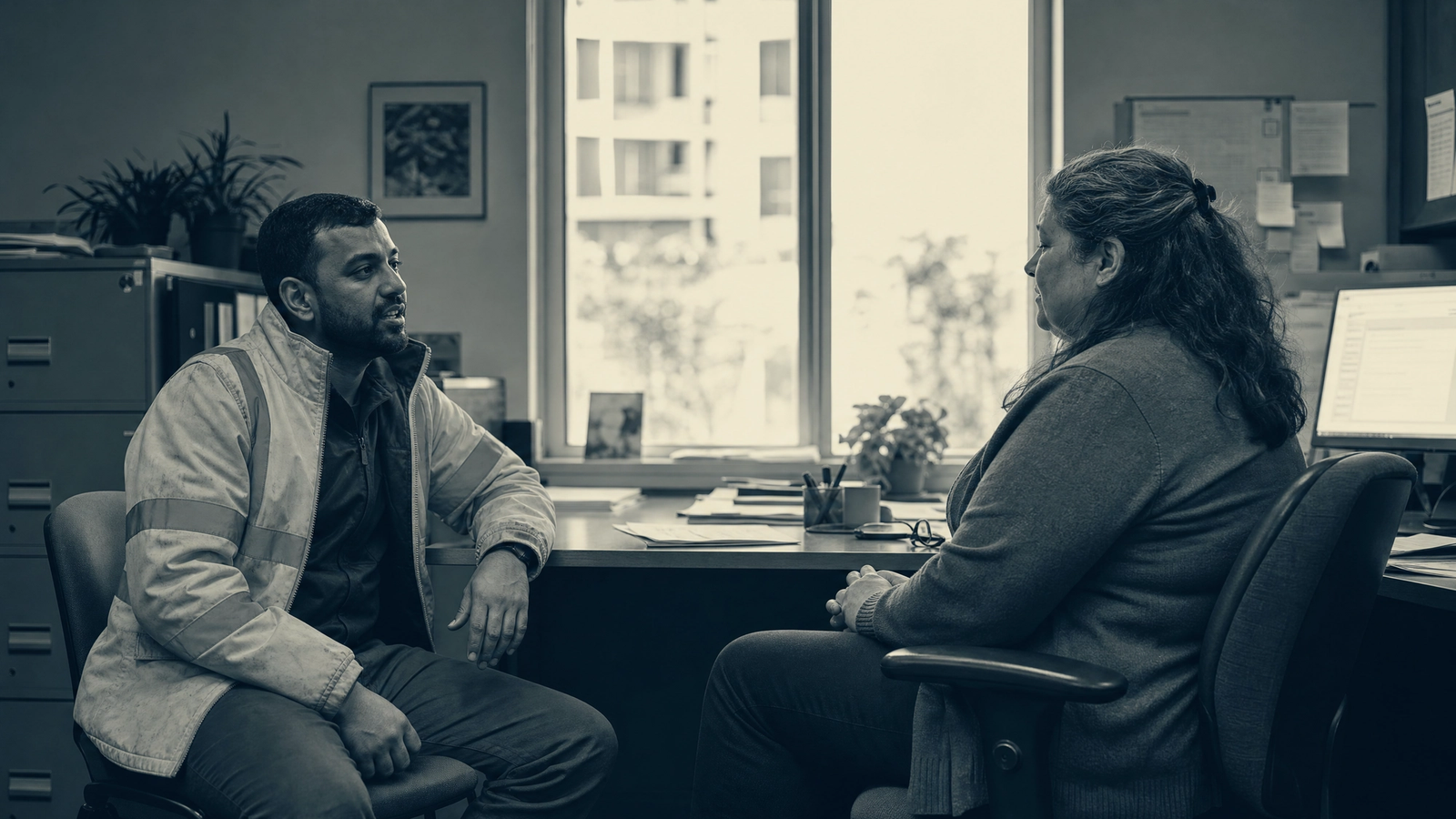
That distinction matters greatly in this system. Contact with an injured worker is more than a service channel. It is part of recovery. Continuous, attentive contact between the case manager and the claimant is essential to trauma-informed, biopsychosocial case management, and especially so when a claim involves psychological injury or mental disorder. Many people can keep working with a condition when the right accommodation is in place. If that support breaks down during a period of disability, poor communication or poor treatment can hinder recovery and return-to-work planning, whatever the condition. Augmented intelligence has real value here: giving case managers the right information at the right time to improve the conversation rather than replace it.
What the evidence shows
This is not a hunch. Three independent bodies of research, though different in strength and design, point in the same direction. Most focus on claimants with psychological injury or mental illness because that is where the research has been done. But the underlying mechanism, how contact and information affect someone who is already in a vulnerable state, applies well beyond that group.
A national Australian study surveyed 10,946 injured workers across ten compensation schemes, 6 to 24 months after their claims were accepted. Workers who described a positive experience of the claims process were working at the time of the survey 84.3% of the time, compared with 64.9% of those who described a negative or neutral experience. Workers with mental health conditions were significantly less likely to report a positive claims experience, and significantly less likely to be working when surveyed. The population most in need of empathic contact was the population most likely to be failed by its absence.
Closer to home, Institute for Work and Health researchers interviewed 996 Ontario workers’ compensation claimants 18 months after a disabling injury. Claimants who reported poor information were 2.58 times as likely to experience serious mental illness; those who reported poor treatment were 3.57 times as likely. Across Canada, the share of lost-time claims that are for mental disorders more than doubled between 2012 and 2022, and PTSD now accounts for close to half of all psychological-injury claims nationally. How information and treatment land on a claimant shapes a growing share of the caseload.
A small UK study used in-depth interviews with 22 employees rather than a large statistical sample, and it adds an important mechanism. It found that sustainable return to work for people with mental health conditions depended on ongoing dialogue and the renegotiation of accommodations over time, not on a single decision point. Workplace stigma and isolation were named as direct drivers of relapse. This is a qualitative, small-scale study and we hold it to that standard, but it explains why a one-time automated interaction cannot substitute for continuity of contact.
What AI can’t do
AI can detect a lot. The technology can notice signals: a pause before someone answers, a shift in tone, signs of vocal stress. But it cannot be present with what that pause means, or carry the moral responsibility that turns a response into care rather than a calculated reply. Researchers studying artificial empathy describe this as “affective inference”: a mechanical response shaped by probability, not emotion. The AI gap isn’t detection. It’s presence.
The clearest public example of what happens when that distinction is ignored is Klarna, which replaced a large share of its customer service team with AI and later reversed course. Its CEO said the AI-first approach produced “lower quality” service, and that investing in the quality of human support is “the way of the future.” NAPSDM does not take this as proof that automation always fails. A 2021 field experiment on humanized chatbots found the opposite where AI was used to support, rather than replace, a human-designed interaction. The pattern, as best the evidence currently shows it, is this: technology that supports human contact tends to improve outcomes, and technology that substitutes for it has a real, documented record of falling short.
Where AI must not go
This is partly about where AI belongs in the process, and partly about where it must never sit. Where psychological safety, distress, trust, judgment, or recovery are at stake, the interaction must remain human. That holds whether the injury or condition is physical, developmental, psychological, or social. AI can support the process, but it should not become the relationship. A claimant’s access to a person must never depend on first persuading a system that their situation is serious enough. If AI is placed at the front door of a claims process, a clear and accessible path to a person must be built in by design, not granted only when the technology decides to escalate.
Where AI must be governed
Contact is one part of the issue. Decision-making is the other, and it carries a different kind of risk. When AI enters a claims process, the usual reassurance is that a human remains “in the loop.” The Dutch child-benefits scandal showed how that safeguard can fail. Human reviewers were involved, yet they could not see how the system had generated its risk scores. The oversight existed on paper but could not meaningfully challenge the machine’s conclusions, and tens of thousands of families were wrongly investigated as a result.
Research suggests this is a broader problem. A 2024 meta-analysis of 106 studies found that human-AI teams often performed worse than either the human or the AI acting alone. The greatest harms appeared in situations where the AI was already the stronger performer. The lesson is not that AI should be excluded from decision-making, but that oversight has to be real. The questions that matter are what reviewers can see, what they can change, what they can audit after the fact, and to whom they are accountable.
The principle behind this is not new. In 1999, the Supreme Court of Canada held in Grismer that individuals must be assessed on their own abilities, not on presumed group characteristics. Predictive models, by definition, draw on group-level patterns. Where AI is used in claims processes, safeguards are therefore essential. We propose three requirements that any organization could adopt now and any claimant could verify: a named person accountable for each decision, a reviewer who can see and audit the basis for the system’s recommendation, and a claimant who is told AI was involved and given an opportunity to correct the record before it is relied upon.
Exactly which decisions require these protections, and what a compliant process looks like in practice, is the work of the standard we are developing. This article identifies where governance is required. The standard will define what that governance has to include.
Our position
NAPSDM is not against AI. We accept that it will have an increasingly important role in delivering a consistently psychologically safe disability management experience, and we want to see it succeed. Our position is straightforward. When any organization, whether an insurer, a compensation board, an employer, or a third-party administrator, integrates AI into claimant-facing work, be clear up front about what you expect to gain, whether that is efficiency, a better claimant experience, or better health and return-to-work outcomes. Then measure what happens to the people, before and after, not only what happens to the process. Publish what you find, including what did not work. The evidence will show whether it was the right call, and when it was not, we want the whole community to learn from it. Don’t bury it. Failure is often where the system learns the most.
The standard must also carry the claimant’s own stake in it. If AI contributes information used to handle a claim, the claimant should be able to know it was involved, correct what is wrong before it affects a decision, and identify who made the decision and who is accountable for it. AI should never make any of that less clear. Our charter names trust, fairness, transparency, consistency, and respectful communication as themselves therapeutic factors in return to work, and any credible measure of success has to include whether the process itself added to someone’s distress, not only whether it hit its efficiency target.
Our charter says it in one line: the claimant is a person, not a file. Psychological safety is not a mood. It is a condition that recovery and return to work depend on, and how someone is treated while their claim is being decided is part of that condition, not separate from it.
We’re not writing this against any insurer, employer, or system. There is no Canadian standard yet for a psychologically safe, AI-supported claims experience. That’s the gap we exist to close: pro-standard, not anti-anyone.
Read our founding principles, add your name to the charter, and if this is work you want to help build, volunteer your time at napsdm.ca.